Patients often come to us with a list of concerns. Acne scars from years ago. Hair that’s been thinning for the past two years. Texture that’s never quite evened out. They want to know if there’s one thing that can start addressing all of it or if they’re looking at a different treatment for every concern.
For a lot of those patients, microneedling is the answer. And the reason it works so well isn’t complicated: it works with your skin’s own biology, not around it.
What’s Actually Happening During a Microneedling Treatment
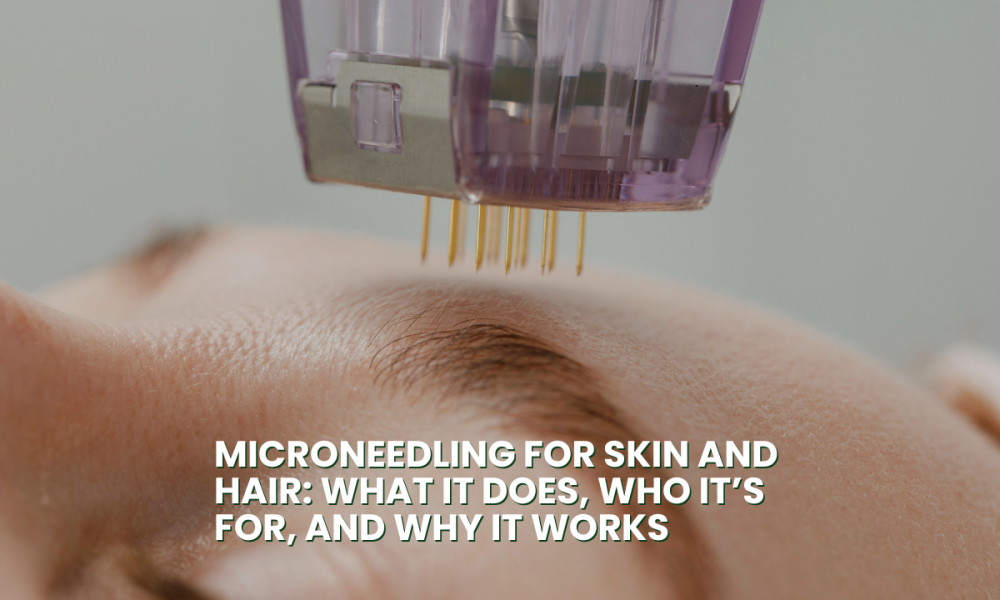
When we perform microneedling, a device fitted with fine, sterile needles creates thousands of tiny channels in the skin. That sounds scarier than it is, but rest assured that microneedling is not painful and numbing cream is provided.
What those micro-punctures actually do is send a signal to your body that reads as damage that needs to be repaired. Your body then responds by ramping up collagen and elastin production; speeding up cell turnover and activating your skin’s natural healing process.
The result, over a series of sessions, is skin that genuinely looks and behaves differently. Not because something was added or injected, but because your skin was prompted to do more of what it’s already capable of.
When we combine microneedling with growth factor serums or peptides, those same channels become delivery routes, allowing active ingredients to reach layers of the skin that no topical product can penetrate on its own.
What It Can Do for Your Skin
We use microneedling to address a wide range of concerns, and that versatility is part of what makes it such a useful tool:
- Acne scars and post-inflammatory hyperpigmentation (PIH)
- Fine lines and early skin laxity
- Enlarged pores and uneven texture
- Uneven skin tone, including certain cases of melasma
- Stretch marks
- Dull, tired-looking skin that’s lost its glow
For patients with melanin-rich skin, microneedling offers a particular advantage:it delivers meaningful resurfacing results without the risk of post-inflammatory pigmentation that can come with some laser treatments.
“Dr. Obayan and the staff are really nice and welcoming. I do enjoy my visits and we are able to list issues and pick the high point ones to talk about. Dr Obayan is very knowledgeable and gives great tips and advice for skin care or any care relating to your issue. ”
— Berkel F. (Verified Google Review)
Book an appointment with Dr. Obayan to find out whether microneedling is the right fit for your skin goals.
What Microneedling Can Do for Your Hair
The same principles that make microneedling so effective for the face apply directly to the scalp. Passing the device over thinning areas activates growth factors, improves blood flow, and wakes up the follicular stem cells that are responsible for regrowth. Studies have shown real improvements in hair density with microneedling alone and when it’s combined with PRP or topical minoxidil, results improve further. At Nature of Skin, scalp microneedling is one part of a comprehensive hair loss treatment plan that considers the full picture: hormonal health, nutrition, and the treatments most likely to work for you specifically.
Why the Right Hands Matter: Especially for Deeper Skin Tones
At Nature of Skin, patients with deeper skin tones aren’t a special case:they’re central to who we are as a practice. Dr. Obayan’s specialized training and experience with skin of color means that every microneedling protocol is calibrated with your biology in mind. Needle depth, treatment intensity, serum selection, and post-care are all adjusted to protect against PIH and maximize your results.
Patients with Fitzpatrick skin types IV–VI can absolutely benefit from microneedling. For many, it offers results that laser-based treatments simply can’t safely deliver.
What to Expect at Your Appointment
We’ll start by applying a topical numbing cream about 20 to 30 minutes before treatment. Once your skin is comfortable, the device moves across the treatment area in a controlled pattern: most sessions take between 30 and 60 minutes.
Afterward, your skin will look and feel like a mild sunburn for a day or two. Most patients are back to their normal routines within 48 hours. Because treated skin is more sensitive to sun exposure during healing, diligent SPF is essential. Dr. Obayan will walk you through a complete post-care protocol before you leave.
How Many Sessions Will You Need?
Results build over time. For concerns like acne scarring or uneven texture, most patients see meaningful improvement after 3 to 6 sessions spaced 4 to 6 weeks apart, with maintenance treatments every 6 to 12 months to keep results going. For hair loss, we typically start with a series of 6 monthly sessions.
Dr. Obayan will give you a clear, realistic picture of what to expect for your specific concerns during your consultation: no vague promises, just an honest plan.
Ready to See What’s Possible?
Whether you’re dealing with acne scars you’ve carried for years, hair that’s been thinning longer than you’d like to admit, or skin that just doesn’t look the way it used to: there’s a path forward.
Your skin has more capacity to repair itself than you might think. Book a consultation with Dr. Obayan and find out what it’s actually capable of.