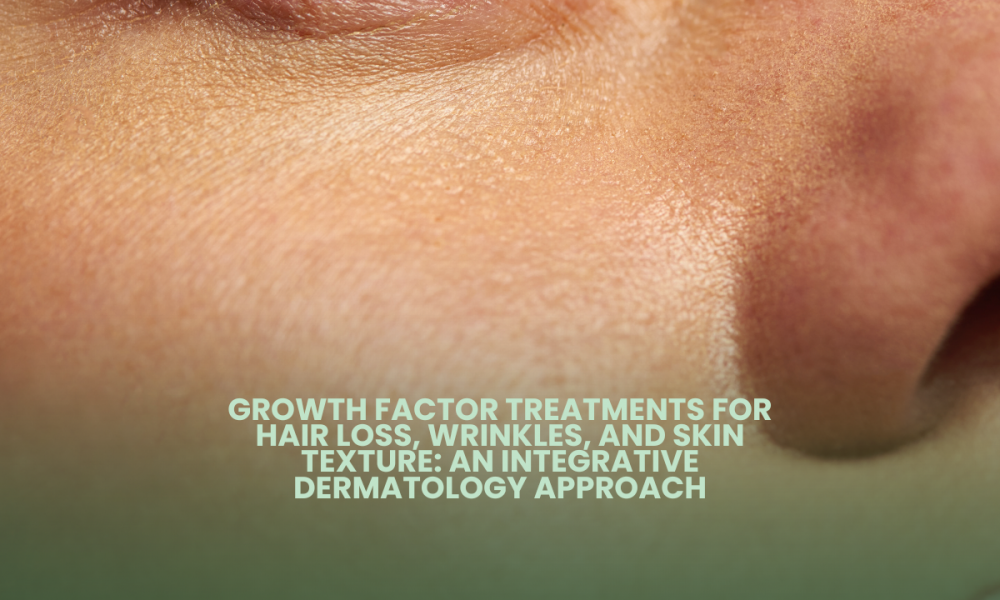
What if your skin had the ability to meaningfully reverse the signs of aging, not through synthetic fillers or surface-level treatments, but by reactivating the biological processes it used to perform naturally? Peptides and growth factor therapy represent two of the most exciting frontiers in integrative dermatology, and at Nature of Skin, they sit at the intersection of evidence-based medicine and our whole-person approach to skin health.
What Integrative Dermatology Actually Means and Why It Changes How We Treat Skin
Integrative dermatology combines the best of conventional medical dermatology with evidence-informed approaches that consider the whole patient: lifestyle, nutrition, stress, hormonal health, and intrinsic biology alongside targeted procedural treatments.
Peptides and growth factor therapies fit naturally within this framework. Rather than introducing foreign substances into the body, these treatments work by amplifying and directing the skin’s own regenerative machinery. For patients who are drawn to treatments that align with their body’s biology, this approach often resonates deeply.
Integrative dermatology doesn’t mean choosing between science and nature, it means using both intelligently, guided by evidence and tailored to each individual patient.
“Dr. Obayan is patient, listens/understands and is empathetic to my situation. She provided helpful information and tips of things I could do at home. I will continue to receive care from her.”
— K ‘MsKay’ M. (Verified Google Review)
How Growth Factors Address Hair Loss at the Follicle Level
Hair loss is one of the most emotionally significant skin conditions we treat at Nature of Skin. Whether it presents as gradual thinning, a receding hairline, or diffuse shedding, the impact on self-confidence can be profound and the path forward often requires a multi-pronged approach.
Growth factors support hair restoration in several interconnected ways:
- Prolonging the anagen (active growth) phase of the hair cycle
- Strengthening and protecting existing follicles from miniaturization
- Improving the vascular supply to follicles, ensuring they receive the oxygen and nutrients they need
- Reducing scalp inflammation, which is increasingly recognized as a contributor to hair loss
At Nature of Skin, PRP scalp injections and, in appropriate cases, PDGF-enhanced preparations are integrated into a broader hair loss treatment plan that may include topical therapies, nutritional assessment, hormonal evaluation, and lifestyle modifications.
For many patients, this comprehensive approach produces results that no single therapy could achieve alone.
Why Growth Factors and Peptides Improve Wrinkles Differently Than Botox or Fillers
Fine lines and wrinkles are primarily the result of declining collagen and elastin production: two structural proteins that give youthful skin its firmness, bounce, and resilience. Growth factors address this at the source by stimulating fibroblasts (the cells responsible for collagen and elastin synthesis) to ramp up production. Peptides work through a complementary pathway: these short chains of amino acids act as biological messengers, signaling fibroblasts to produce more collagen and instructing the skin to repair itself more actively. Together, growth factors and peptides create a more complete stimulus for structural skin renewal than either can achieve alone.
This is meaningfully different from how neurotoxins (like Botox) or dermal fillers work. Rather than relaxing muscles or adding volume, growth factor and peptide-based therapies work by actually improving the quality and quantity of the skin’s structural matrix.
Growth factor treatments are often most effective when delivered in combination with microneedling, which:
- Creates controlled micro-injuries that trigger the skin’s healing cascade
- Opens micro-channels for deep penetration of growth factor serums and peptide-rich topicals
- Stimulates additional collagen remodeling in its own right
The combination is synergistic: the microneedling amplifies the growth factor delivery, and the growth factors supercharge the healing response triggered by the needling.
Beyond Wrinkles: How Growth Factor Therapy Improves Overall Skin Quality
Beyond wrinkles and hair, growth factor therapy has shown meaningful benefits for overall skin quality, including improvements in:
- Pore size and appearance
- Surface texture and smoothness
- Skin tone evenness and luminosity
- Acne scarring and post-inflammatory pigmentation
- Skin hydration, barrier function, and resilience: areas where peptide-enriched topicals also play a meaningful supporting role
For patients dealing with the aftermath of acne, whether in the form of textural scarring, enlarged pores, or persistent discoloration, growth factor-enhanced microneedling protocols offer one of the most effective non-surgical approaches available.
Your face deserves a plan made for it. Book with Dr. Obayan and get exactly that.
How Dr. Obayan Builds a Growth Factor and Peptides Treatment Plan from the Ground Up
When a patient comes to us seeking growth factor therapy, we don’t begin with a needle. We begin with a conversation.
Dr. Obayan’s approach to treatment planning considers the full picture: What is driving the concern? Is it primarily genetic? Hormonal? Sun-related? Stress-related? How does the patient’s nutrition, sleep, and lifestyle contribute? Are there topical or systemic treatments that should accompany the in-office procedure to optimize results?
Growth factor therapy may be recommended as a standalone treatment, or as part of a layered program that might include:
- Nutritional guidance to support collagen synthesis and hair follicle health
- Medical-grade topical products containing growth factors, peptides, and their biological precursors: selected specifically for your skin’s needs
- Hormonal assessment for patients with hair loss that may have an endocrine component
- Combination in-office procedures (e.g., microneedling + PRP, or laser + growth factor serum)
- Maintenance protocols to sustain and build upon initial results
What to Realistically Expect: Timeline, Sensations, and Recovery
Growth factor therapies are generally well-tolerated. PRP scalp injections may cause mild discomfort and temporary scalp tenderness for a day or two. Microneedling with growth factor serum typically results in mild redness for 24–48 hours. Most patients return to normal activities quickly.
Results develop gradually over weeks to months as the biological processes stimulated by treatment unfold. Hair regrowth typically becomes noticeable after 3–6 months of consistent treatment. Skin improvements often become evident within 4–8 weeks, with ongoing enhancement for up to 6 months after a series.
Maintenance sessions are generally recommended to sustain results, as the underlying biological decline that drives aging and hair loss is ongoing.
The patients who tend to see the best outcomes are those who embrace the process, understanding that these treatments are working with their biology, not against it, and that meaningful change takes time.
Is Growth Factor Therapy the Right Fit for Your Skin or Scalp Goals?
If you are currently struggling with thinning hair, acne scars, hyperpigmentation and uneven texture, growth factor and peptide therapies may be right for you. Start a conversation about Growth Factor Therapies and Peptides with Dr. Obayan and get a personalized plan that makes sense for your life and your face.
Book An Appointment