

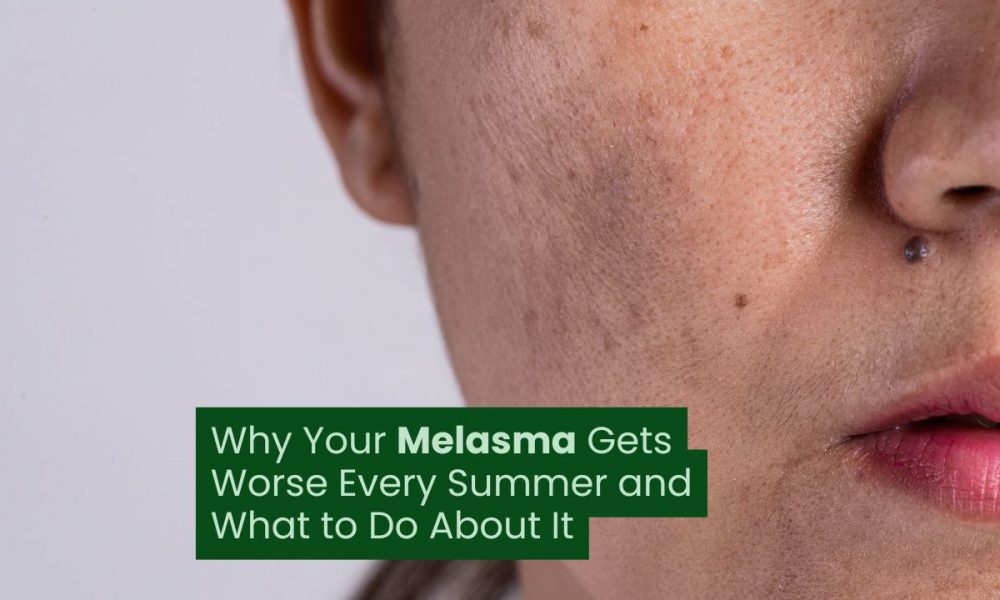
If there’s one thing patients with melasma know, it’s this: the moment the weather turns warm, the patches come back. Sometimes gradually, sometimes seemingly overnight. You’ve been diligent all winter. You’ve been using your products. And then April hits and it feels like you’re starting over.
You’re not imagining it. And you’re not doing anything wrong. Melasma has a real, biological relationship with heat, light, and hormones and understanding it is the first step toward actually getting ahead of it.
Melasma develops when melanocytes, the cells responsible for producing pigment, become overactive and deposit excess melanin in localized areas. The result is the familiar brown or grayish-brown patches that tend to appear on the cheeks, forehead, upper lip, and chin.
While melasma can affect any skin tone, melasma primarily affects people with medium to deeper skin, and it has a strong hormonal component. Pregnancy, oral contraceptives, and perimenopausal hormonal shifts are among the most common triggers, which is why it’s sometimes called the mask of pregnancy.
UV radiation is the primary external driver of melasma flares. Even brief UV exposure like the walk from your car or a few minutes near a sunny window can be enough to deepen existing patches.
But UV isn’t the only culprit, and this is something a lot of patients don’t know. Visible light, particularly high-energy visible (HEV) light, has been shown to trigger melanocyte activity in patients with skin of color, which means that even indoors under bright lighting, melasma can worsen. And heat itself plays a role too: elevated skin temperature can stimulate melanin production entirely independent of sun exposure.
Here in Austin, where summers are long, intense, and humid, patients with melasma are facing all three of these triggers at once for months at a time.
There’s no single treatment that cures melasma permanently; it’s an ongoing management situation. But with the right strategy, most patients see significant, lasting improvement. At Nature of Skin, we build every melasma plan around three things working together:
This is the foundation, and it’s non-negotiable. Patients with melasma need broad-spectrum protection against UVA, UVB, and visible light, which means mineral-based sunscreens, ideally tinted formulas that physically reflect visible light, reapplied every two hours. For patients with deeper skin tones who have avoided mineral sunscreens because of the white cast, tinted options have changed the game entirely.
Hats, shade, and avoiding peak sun hours (10 a.m. to 4 p.m.) aren’t optional additions: they’re part of the plan.
The right combination of topicals depends entirely on your skin tone, sensitivity, and the nature of your melasma. What Dr. Obayan recommends may include some combination of:
What works beautifully for one patient may not be appropriate for another. This is why a one-size protocol doesn’t exist at Nature of Skin and why it shouldn’t.
“Dr. Obayan was fast, knowledgeable, and helpful and will continue to return . ”
— Adrian O.(Verified Google Review)
Schedule a consultation with Dr. Obayan for a melasma plan built specifically around your skin.
For patients who want to go further, in-office treatments can work alongside a home regimen to address what topicals alone can’t reach. Chemical peels formulated for melasma and skin of color, carefully selected laser protocols, and microneedling-based approaches can all play a role, particularly for the deeper, dermal component of melasma that doesn’t respond well to surface treatments.
One important caveat: in the wrong hands, in-office treatments can make melasma dramatically worse. Aggressive peels or inappropriate laser settings in deeper skin tones can trigger post-inflammatory hyperpigmentation that’s harder to treat than the original concern. Choosing a dermatologist with genuine expertise in skin of color isn’t just a preference here: it’s essential.
For patients whose melasma is primarily hormonal driven by contraceptive use, pregnancy, or perimenopausal changes, topical and procedural approaches alone often hit a ceiling. Dr. Obayan’s integrative approach means we look at the whole picture, including a review of the medications and supplements that may be contributing to what’s happening on your skin.
If your melasma reliably worsens every summer, the most important thing you can do is get ahead of it before the pigmentation deepens, not after. Start or optimize your sunscreen routine now. Review your topicals with a dermatologist. And don’t wait until you’re already frustrated with what you see in the mirror.
Melasma is manageable. With the right guidance, most patients see real, lasting improvement: even through an Austin summer.
Summer is coming whether your skin is ready or not. Book with Dr. Obayan and make sure it is.